

📰 EDITOR’S DESK | HROSTRUM.COM
There is a moment every HR leader encounters but rarely speaks about publicly.
It does not appear in dashboards.
It does not surface cleanly in engagement surveys.
And yet, it quietly shapes culture more than any policy ever could.
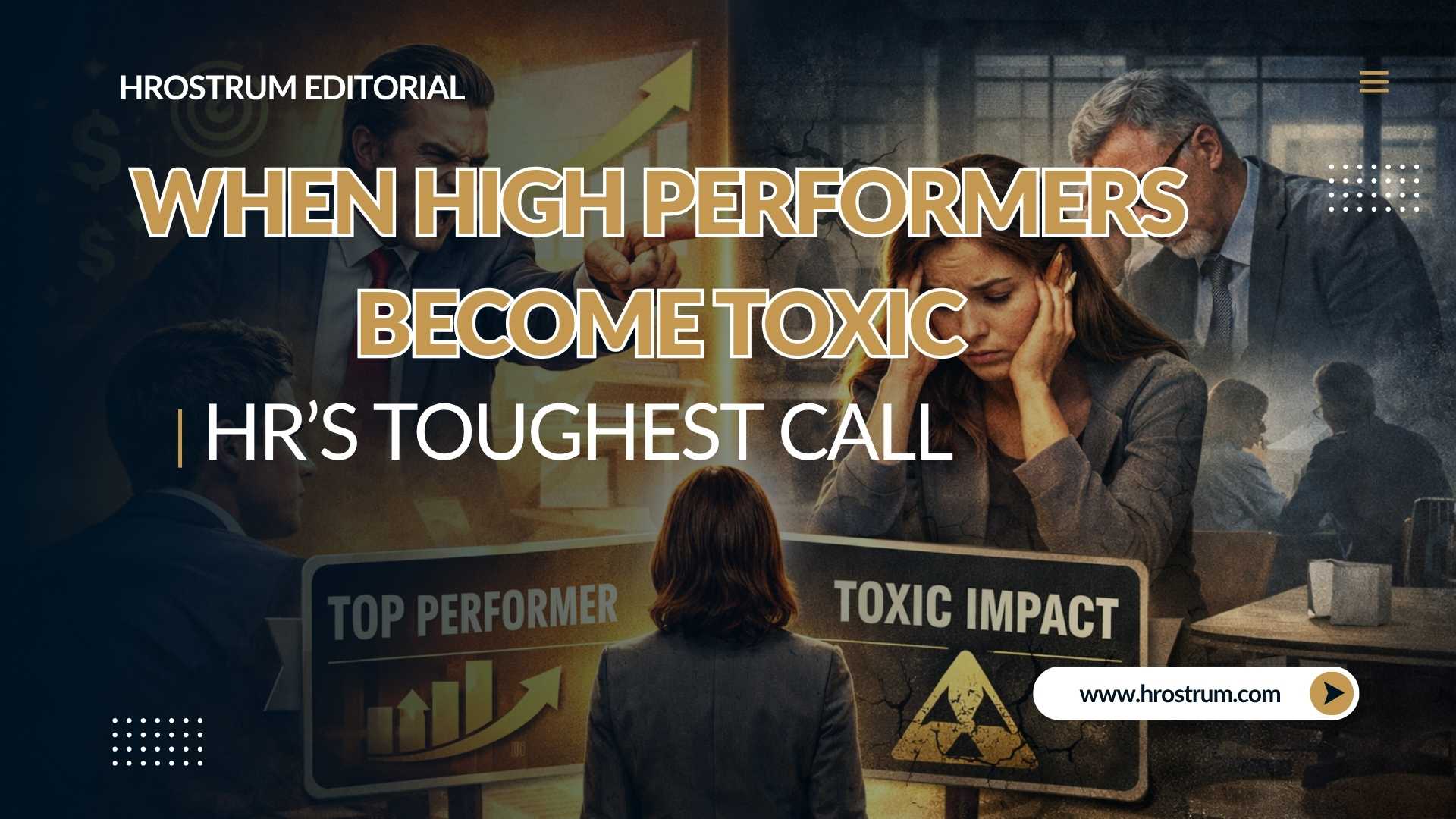
It is the moment when your best performer becomes your biggest cultural risk.
The Uncomfortable Truth Organizations Avoid
Every organization celebrates high performers.
They are the rainmakers.
The problem solvers.
The ones leadership leans on when stakes are high.
But here is the paradox:
The same individuals who drive extraordinary results can also quietly erode the very culture that sustains those results.
- They deliver, but intimidate
- They outperform, but alienate
- They win business, but lose people
And because they perform,
their behavior gets discounted… rationalized… sometimes even rewarded.
This is where HR’s toughest dilemma begins.
The “Brilliant Jerk” Dilemma
Most HR professionals recognize this archetype instantly.
The employee who:
- Consistently exceeds targets
- Is indispensable to business outcomes
- But leaves behind a trail of disengaged teammates
Managers often defend them:
“Yes, they’re difficult… but they get things done.”
Leadership hesitates:
“Let’s not disrupt performance.”
And HR stands at the crossroads of culture vs commercial reality.
Because the real question is not:
“Are they performing?”
The real question is:
“At what cost?”
The Hidden Cost of Tolerating Toxic Excellence
Toxic high performers rarely create visible, immediate damage.
Their impact is subtle. Cumulative. Cultural.
- Strong team members quietly disengage
- Collaboration declines
- Psychological safety erodes
- Average performers stop stretching
Over time, what remains is a culture of:
- Compliance over creativity
- Silence over feedback
- Output over empathy
Ironically, one high performer can gradually reduce the performance of many.
And yet, because this cost is not directly measurable, it is often ignored until it is too late.
Why Organizations Struggle to Act
If the problem is so evident, why is action so rare?
Because this is not just a people issue.
It is a power equation.
- Revenue Bias
High performers are often tied to critical business outcomes. Letting them go feels like a financial risk. - Leadership Dependence
Senior leaders may have built reliance on these individuals, making objectivity difficult. - HR Positioning
HR is expected to protect culture, but not at the cost of performance. This creates an inherent tension. - Lack of Clear Frameworks
Most organizations do not define “unacceptable behavior” for high performers differently from average ones.
The result?
Delayed decisions. Diluted actions. Compromised culture.
Where HR Must Step In: The Courage to Redefine Performance
This is where HR must move from being a facilitator… to being a culture custodian with conviction.
The shift is subtle but powerful:
From:
“Performance is what you achieve”
To:
“Performance is how you achieve it”
Organizations that get this right do three things consistently:
1. Make Behavior Measurable
Culture cannot remain abstract.
- Define non-negotiables
- Integrate behavior into performance reviews
- Link leadership conduct to rewards
When behavior is measured, it becomes manageable.
2. Remove the “Exception Clause”
The fastest way to dilute culture is to create exceptions for high performers.
Once teams see that:
“Results excuse behavior”
…trust is permanently damaged.
Consistency, even when uncomfortable, builds credibility.
3. Equip Managers for Difficult Conversations
Many managers avoid confronting toxic high performers because:
- They fear losing them
- They lack the language to address behavior
HR must enable:
- Structured feedback frameworks
- Coaching conversations
- Clear escalation paths
Because silence is not neutrality.
It is endorsement.
The Hardest Decision: When Change Doesn’t Happen
There will be cases where:
- Feedback is given
- Coaching is provided
- Time is invested
…and yet, behavior does not change.
This is the defining moment.
Because at this point, the organization is no longer evaluating the employee.
It is revealing its own values.
Letting go of a high performer is never easy.
But holding on to a toxic one is far more expensive in the long run.
Editor’s Perspective: Culture is a Leadership Choice, Not an HR Policy
The conversation around toxic high performers is not about individuals.
It is about organizational courage.
Every organization, consciously or unconsciously, answers this question:
“What are we willing to tolerate in the name of performance?”
HR does not own this answer alone.
But it must be the function that forces the question to be asked.
Closing Reflection
In today’s hyper-competitive landscape, performance matters.
But sustainable performance is never built on fear, intimidation, or silent disengagement.
The real differentiator is not how organizations reward excellence.
It is how they respond when excellence comes with a cost.
Because in the end,
Culture is not defined by your best values.
It is defined by your toughest decisions
Contribute to HRostrumHR
Have a perspective on HR, leadership, talent, or the future of work that the world should hear?
HROstrum welcomes HR leaders, CXOs, and industry experts to share their voice and influence the next wave of people strategy.
Submit your articles at editor@hrostrum.com and become part of our expanding network of industry changemakers.
🔗 Follow HRostrum on LinkedIn
🔗 Read related articles here