
📰 EDITOR’S DESK | HROSTRUM.COM
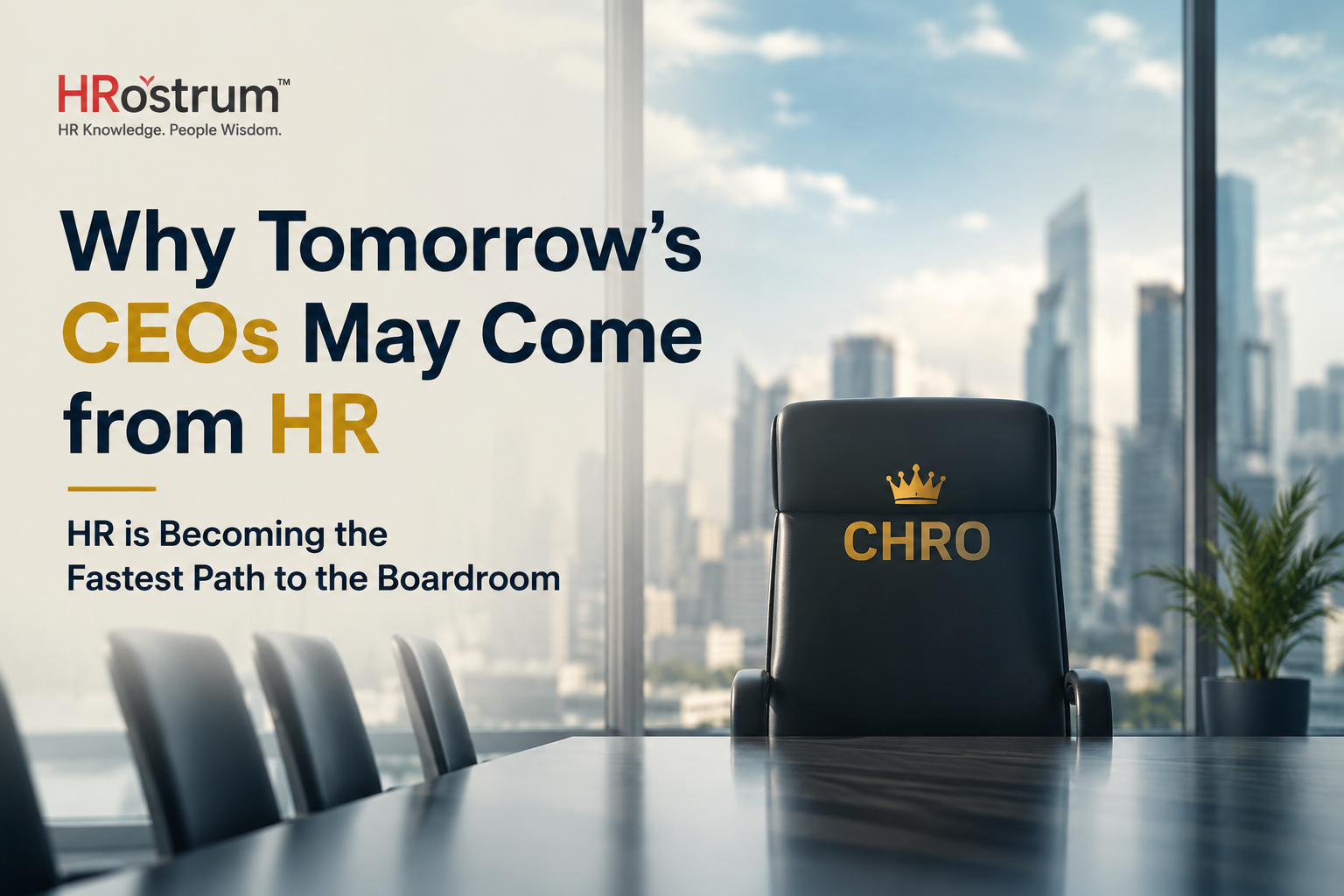
HR is Becoming the Fastest Path to the Boardroom
For decades, the path to the CEO’s office was remarkably predictable. Future chief executives typically emerged from finance, sales, operations, or strategy. Human Resources, despite being responsible for an organization’s most valuable asset—its people—was often viewed as a support function rather than a business driver.
That perception is changing.
As businesses navigate economic uncertainty, rapid technological disruption, geopolitical instability, demographic shifts, and evolving workforce expectations, the role of the Chief Human Resources Officer has expanded dramatically. Today’s CHRO is no longer responsible solely for hiring, performance management, or employee engagement. Instead, they are increasingly shaping business strategy, organizational transformation, leadership succession, culture, mergers and acquisitions, workforce planning, and enterprise resilience.
Increasingly, boards are looking for leaders who can manage not just profit and loss, but also complexity, adaptability, and long-term organizational health. Those capabilities sit at the heart of modern HR leadership.
The CEO of tomorrow may not come from finance. They may come from Human Resources.
Why HR Is Uniquely Positioned
Modern organizations compete less on physical assets and more on talent, innovation, and execution. HR leaders oversee the systems that influence all three.
Unlike many functional executives, CHROs regularly interact with every business unit, every leadership team, and the board itself. They understand organizational capability, succession pipelines, executive performance, culture, compensation, and change management better than anyone else.
This enterprise-wide perspective is becoming a strategic advantage.
The New Expectations from CHROs
The role is evolving beyond traditional people management.
Today’s leading CHROs are expected to:
- Drive business transformation
- Influence corporate strategy
- Lead organizational restructuring
- Guide mergers and acquisitions integration
- Shape ESG and corporate governance initiatives
- Build future-ready leadership pipelines
- Use workforce analytics for business decisions
- Strengthen organizational resilience during uncertainty
The distinction between business leadership and people leadership is rapidly disappearing.
A Roadmap for CHROs Aspiring to Become CEOs
Stage 1: Build Commercial Acumen
Move beyond HR metrics.
Understand:
- Revenue models
- Profitability
- Customer acquisition
- Market dynamics
- Investor expectations
- Competitive strategy
Every HR decision should ultimately improve business outcomes.
Stage 2: Own Enterprise Transformation
Volunteer to lead initiatives beyond HR.
Examples include:
- Digital transformation
- Organizational redesign
- Productivity improvement
- Shared services
- Post-merger integration
- Workforce restructuring
Transformation experience demonstrates enterprise leadership.
Stage 3: Become Fluent in Finance
Future CEOs must speak the language of investors.
Master:
- P&L interpretation
- EBITDA
- Cash flow
- Capital allocation
- Financial planning
- Return on investment
HR investments should increasingly be justified through measurable business impact.
Stage 4: Become a Technology Leader
The future CEO will lead digital enterprises.
CHROs should understand:
- Cloud platforms
- Cybersecurity
- Automation
- Data governance
- Workforce analytics
- Digital operating models
Technology literacy is now a leadership requirement.
Stage 5: Build a Personal Brand
The most influential CHROs are visible thought leaders.
Publish regularly.
Speak at conferences.
Mentor emerging leaders.
Engage with industry forums.
Contribute to public discussions on the future of work.
Visibility builds credibility.
Stage 6: Gain Boardroom Experience
Aspiring CEOs should actively seek exposure to governance.
This could include:
- Board presentations
- ESG committees
- Risk committees
- Advisory boards
- Startup mentoring
- Independent director opportunities
Boardroom confidence develops through participation.
Stage 7: Lead Beyond HR
The strongest CEO candidates have managed businesses—not just functions.
Seek opportunities to oversee:
- Business units
- Shared services
- Corporate strategy
- Operations
- Customer experience
- Innovation programs
Cross-functional leadership broadens perspective and demonstrates readiness.
Skills That Will Define the CEO-Ready CHRO
- Strategic Thinking
- Financial Acumen
- Technology Fluency
- Crisis Leadership
- Change Management
- Corporate Governance
- Data-Driven Decision Making
- Stakeholder Management
- Investor Communication
- Global Leadership
- Innovation Mindset
The Future Belongs to Enterprise Leaders
The most successful organizations of the next decade will be those that can attract, develop, and retain exceptional talent while navigating constant disruption. That challenge is no longer just an HR issue—it is a business imperative.
As the boundaries between people strategy and business strategy continue to dissolve, the qualities that define an exceptional CHRO increasingly mirror those required of an exceptional CEO.
The question is no longer whether HR leaders belong in the boardroom. They already do.
The real question is: Who will become the first CEO from your HR function?
HRostrum Insight
The next generation of CEOs may not emerge from finance, sales, or operations alone. They will emerge from leaders who understand people, strategy, technology, governance, and business in equal measure. For today’s CHROs, the journey to the corner office is no longer an exception—it is an increasingly achievable career path for those willing to broaden their capabilities beyond traditional HR boundaries.
#CHRO, #CEO, #CHROtoCEO, #FutureCEO, #BoardroomLeadership, #LeadershipDevelopment, #ExecutiveLeadership, #BusinessStrategy, #CorporateLeadership, #PeopleStrategy, #StrategicHR, #HRLeadership, #LeadershipRoadmap, #FutureOfWork, #Boardroom, #CSuite, #LeadershipTransformation, #TalentStrategy, #HRTransformation, #HRostrum
Contribute to HRostrumHR
Have a perspective on HR, leadership, talent, or the future of work that the world should hear?
HROstrum welcomes HR leaders, CXOs, and industry experts to share their voice and influence the next wave of people strategy.
Submit your articles at editor@hrostrum.com and become part of our expanding network of industry changemakers.
🔗 Follow HRostrum on LinkedIn
🔗 Read related articles here